
Dive Health & Safety
Are there sharks in Hurghada? What swimmers, snorkelers and divers should know
Yes. Around 30 shark species live in the Red Sea. Reef sharks such as whitetip and blacktip reef sharks live on coral reefs, while big open-water species are mostly seen at offshore reefs. Bites are rare: the fatal ones reported near Hurghada in recent years were two at Sahl Hasheesh in July 2022 and one in Hurghada in June 2023. Swim in marked areas, never feed fish and respect any beach closure.
By 71 Guardians · Published 03 Nov 2026
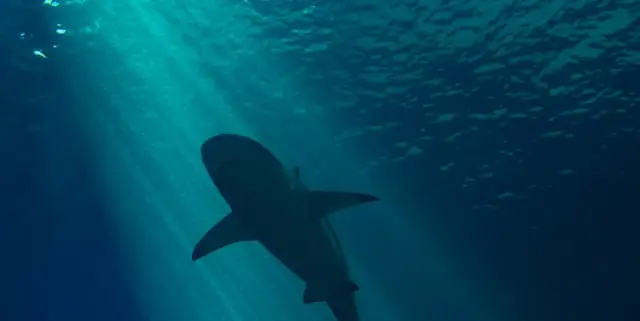
Which sharks live in the Red Sea around Hurghada?
Egypt's diving chamber (CDWS) hosts a species guide written by the Hurghada-based shark biologist Dr Elke Bojanowski of the Red Sea Sharks project (January 2019). It says around 30 shark species live in the Red Sea and describes where each one is usually found. It covers the whole Egyptian Red Sea; no public survey lists sharks reef by reef for Hurghada, so read the table as habitats, not a promise of what you will meet.
| Shark | Where it usually lives (per the guide) | How often (the guide's word) |
|---|---|---|
| Whitetip reef shark | On or near the bottom, in crevices or caves in coral reefs, and in lagoons; up to about 2 m long | Common |
| Blacktip reef shark | Very shallow water on coral reefs and reef flats; under 2 m | Locally common |
| Grey reef shark | Coral reefs near drop-offs with strong currents; about 2 m | Common |
| Scalloped hammerhead | Next to islands and shelves over deep water, often close inshore as well | Common |
| Tiger shark | From the surface to 140 m, often close to coral reefs or in lagoons; over 5.5 m | Rather uncommon |
| Oceanic whitetip | Open ocean, usually far offshore; near drop-offs in season | Seasonally common |
| Silky shark | Open ocean over water deeper than 200 m; near offshore reefs and drop-offs in season | Seasonally common |
| Pelagic thresher | Usually offshore, sometimes near reef drop-offs and seamounts | Locally common |
| Shortfin mako | Coastal and open ocean, 0–500 m | Rather uncommon near dive sites |
| Whale shark (a plankton feeder) | Open ocean to close inshore off beaches, reefs and islands | Seasonally common in certain areas |
The same guide names the offshore walls of the Brothers and Daedalus among the best places in the world to meet sharks. That is liveaboard territory, covered in our guides to the Brothers, Daedalus and Elphinstone route and oceanic whitetip sharks.
Have there been shark attacks in Hurghada?
Yes, but they are rare. These are the incidents near Hurghada that reliable news agencies and Egypt's Ministry of Environment reported in recent years:
| When | Where | What was reported | Shark |
|---|---|---|---|
| 1 and 3 July 2022 | Sahl Hasheesh, south of Hurghada | Two women died in separate attacks about 600 m apart: a 68-year-old Austrian who lived in Egypt, and a Romanian tourist in her late forties (Reuters, Ministry of Environment). | Early reports named a mako; dive press later said it was thought to be an oceanic whitetip. We found no final official finding. |
| 8 June 2023 | Off Hurghada | A Russian man in his twenties who lived in Hurghada died (AP, Ahram Online). | Tiger shark, according to the Ministry of Environment, which said it caught the shark and examined it in a laboratory. |
| December 2024 | Northern Marsa Alam, farther south | One tourist died and one was injured. The ministry said it happened in deep water outside the designated swimming zone near the jetties (Reuters). | Not named in the ministry statement |
Earlier cases happened elsewhere on Egypt's coast, including a series of attacks at Sharm el Sheikh in 2010 and incidents in 2018 and 2020. The National counted more than a dozen cases on Egypt's Red Sea coast in the 15 years to 2023. Reports differ on small details such as ages; we have used the wording the agencies agree on.
What did the authorities do after the attacks?
After each incident the authorities closed the sea nearby for a few days and opened an investigation.
- July 2022: the Red Sea governor closed beaches around Sahl Hasheesh for three days, and the Ministry of Environment set up a committee. On 9 July the governor kept the sea from north of Dasht al-Dabaa to Ras Abu Soma closed until 15 July: sandy beaches could be used only to one metre deep, snorkelling in closed reef lagoons was allowed only with a guide (one guide per 10 people), solo snorkelling was banned, diving was limited to licensed divers, fishing was banned along the coast, hotels had to employ enough qualified lifeguards and boats had to bring their waste back to port instead of dumping it at sea.
- The 2022 report: a contemporary news account attributed a seasonal reproductive explanation to a committee of Red Sea protectorate specialists and HEPCA, alongside overfishing, heavy water use and fish feeding. We have not located the committee's original report, so this is not a verified cause or a general shark-attack season. They recommended stopping recreational fishing and keeping snorkelling and diving supervised by licensed guides.
- June 2023: the ministry banned swimming, snorkelling and all water sports for two days on the coast from El Gouna to Soma Bay (AP gave the length as 46 miles, The National as 60 km). It then announced an 18-month, three-stage study of shark movement along about 1,500 km of coast.
- December 2024 (Marsa Alam): the jetties were closed for two days and swimming out from them was prohibited.
How rare are shark bites?
Very rare, worldwide and here. The International Shark Attack File (ISAF) at the Florida Museum investigated 105 alleged shark–human interactions in 2025 and confirmed 65 unprovoked bites around the world, nine of them fatal. It calls the number "extremely low" and in line with the 2020–2024 average of 61 a year. Egypt does not appear in its 2025 list of countries with unprovoked bites.
| Who was in the water (ISAF, 2025 unprovoked bites) | Share |
|---|---|
| Swimmers and waders | 46% |
| Surfers and board sports | 32% |
| Snorkelers and free divers | 15% |
| Other | 6% |
There is no official figure for the risk per visitor in Hurghada, so we don't give one. ISAF counts provoked bites separately; they include divers bitten after harassing or trying to touch a shark.
How can swimmers and snorkelers lower the risk?
The steps below come from ISAF's safety tips, Egypt's own rules and the 2022 committee's findings. None of them makes the sea risk-free, but each one lowers the risk.
- Swim in the marked swimming area. The 2024 Marsa Alam attack happened in deep water outside the designated zone, the ministry said.
- Respect closures, flags and lifeguards. After every incident the authorities closed the water for a few days; stay out until it reopens.
- Never feed fish or sharks. Feeding and baiting sharks is illegal across the Egyptian Red Sea (HEPCA), and the 2022 committee named people feeding fish as one factor that draws animals into shallow water.
- Keep away from fishing. ISAF advises against swimming around schools of fish or where people are fishing.
- Choose your time. ISAF advises not swimming at dawn or dusk.
- Stay close and together. Swim with a buddy, stay close to shore, avoid excess splashing and leave jewellery on land (ISAF).
- Snorkel with a guide on the outer reefs. Guided snorkelling was one of the 2022 recommendations. Our snorkeling trip (€35, mask and fins included) has guides who speak English, Arabic and Czech; see also our snorkeling safety tips.
If a shark comes near you, ISAF says to keep it in sight, move away slowly and leave the water if you can.
What does seeing a shark mean for divers?
Many divers hope to see one. The CDWS species guide notes that sharks bring diving tourists to Egypt, and its monitoring programme asks divers to send in their sightings and photos.
- Stay calm and watch. ISAF's advice to divers: most sharks are curious and will leave on their own, so hold your position quietly and enjoy it.
- Stay with your group. Sharks are less likely to approach a group of divers than a lone diver (ISAF). With us there are never more than 4 divers per guide on the 2-dive day trip (€50, normally €60).
- Never touch or chase one. ISAF's provoked bites include divers who harassed or tried to touch a shark.
- Leave smoothly if it keeps coming closer, keeping it in view and staying near your buddy (ISAF).
Whitetip reef sharks often rest in reef crevices and caves, so you may see one lying still under a ledge. We can't promise a sighting on a Hurghada day dive. If seeing big sharks is your goal, the offshore routes on our liveaboards give you the best chance; read our oceanic whitetip guide for how to behave around them. First time underwater? A try dive (€45) is one-to-one with an instructor.
Frequently asked questions
Are there sharks in Hurghada?
Yes. Around 30 shark species live in the Red Sea, and reef sharks such as whitetip and blacktip reef sharks live on coral reefs like those off Hurghada.
Which recent shark attacks does this article cover near Hurghada?
Two women died in separate attacks at Sahl Hasheesh on 1 and 3 July 2022, and a man died off Hurghada on 8 June 2023 in an attack the ministry blamed on a tiger shark.
Is there a shark season in the Red Sea?
Sharks live in the Red Sea all year. Seasonal sightings at particular offshore reefs do not establish a season when swimming is safe or unsafe. Follow current local closures and lifeguard instructions.
Are beaches closed after a shark attack?
Yes, for a short time: three days around Sahl Hasheesh in July 2022, later extended to 15 July, and two days from El Gouna to Soma Bay in June 2023.
Can I feed the fish while snorkelling?
No. Feeding and baiting sharks is illegal across the Egyptian Red Sea, and the 2022 committee named people feeding fish as one factor that draws animals into shallow water.
Are divers bitten more often than swimmers?
The 2025 ISAF report lists 46% of confirmed unprovoked bites among swimmers and waders and 15% among snorkelers and free divers; scuba divers are not listed separately. Those counts do not establish risk per swimmer or diver, because time spent in the water is not measured.
Will I see a shark on a Hurghada day dive?
Maybe, but nobody can promise it. The best chances of big sharks are on the offshore liveaboard routes such as the Brothers and Daedalus.
Questions before you dive with us?
Message our team on WhatsApp — we're divers in Hurghada and happy to help.
Chat with us on WhatsAppSources
- Shark Monitoring & Species Information: Egyptian Red Sea (Dr Elke Bojanowski, Red Sea Sharks, January 2019) — Chamber of Diving and Water Sports (CDWS)
- Second woman killed in shark attack in Egypt's Red Sea, beaches shut down (Reuters, 3 July 2022) — Cyprus Mail
- Egypt closes Red Sea resort beach after fatal shark attack (3 July 2022) — The National
- Shark attacks close Hurghada dive hotspots (3 July 2022) — Divernet
- Urgent measures in place to confront shark attacks in Hurghada (9 July 2022) — Egypt Independent
- Egypt's shark attack due to mating season: environmental committee (12 July 2022) — Egyptian Streets
- Russian man killed in rare shark attack off Egypt's Red Sea coast (AP, 8 June 2023) — CBS News
- Russian national killed in Red Sea tiger shark attack in Hurghada (June 2023) — Ahram Online
- Sharks of Red Sea under spotlight after swimmer killed in Egypt (9 June 2023) — The National
- Egypt to conduct shark behavior study in Red Sea (22 June 2023) — Amwal Al Ghad
- Protecting Egypt's marine wealth (October 2023) — Ahram Online
- Tourist killed in shark attack in Egypt's Marsa Alam resort (Reuters, 29 December 2024) — VOA News
- Egypt: 10 tips for diving with sharks in the Red Sea (HEPCA advice, 2010) — Ahram Online
- Yearly Worldwide Shark Attack Summary (2025) — International Shark Attack File, Florida Museum
- Reducing your risk: quick tips — International Shark Attack File, Florida Museum
- Reducing your risk: advice to divers — International Shark Attack File, Florida Museum