
Travel & Planning
Snorkeling from the beach in Hurghada: house reefs in El Gouna, Makadi Bay, Sahl Hasheesh and Soma Bay
Yes, but it depends on where you stay. In Hurghada town most good reefs lie offshore, so a boat trip shows you more. Makadi Bay and Soma Bay have reefs you can reach from shore, often by a jetty over the reef top, and Sahl Hasheesh has reefs and an artificial reef in its bay. El Gouna is mostly calm lagoons and sand. Wear water shoes, float instead of standing, and keep clear of boats.
By 71 Guardians · Published 03 Nov 2026
Where can you snorkel straight from the beach around Hurghada?
The reefs you can reach on foot are mainly south of Hurghada, in Makadi Bay and Soma Bay, plus the bay at Sahl Hasheesh. In Hurghada town and El Gouna, beach snorkeling is mostly over sand, seagrass or lagoon, with fish rather than a full reef.
| Area | Where it is | What's in front of the beach | How you reach the reef |
|---|---|---|---|
| El Gouna | About 20 km north of Hurghada | A resort town of about 20 islands surrounded by lagoons; calm, flat water and sandy beaches | Long wooden jetties, such as the one off Zeytouna island, take you to deeper water where fish gather. One visitor found the coral better offshore and booked a boat trip for it. |
| Hurghada town | The city itself | Beaches, many of them hotel beaches; Wikivoyage says no Hurghada beach is free, with public beaches charging about LE50–100 | Wikivoyage says the reefs are several miles offshore, though its own diving section mentions reefs 10 m from some beaches. Plan on a boat. |
| Sahl Hasheesh | About 18 km south of Hurghada airport | A bay with islands and coral reefs, and a partly submerged artificial "Sunken City" that draws fish and snorkelers | Varies by beach; ask where the marked entry is. Abu Hasheesh island in the bay is a protected area. |
| Makadi Bay | About 30 km south of Hurghada | A sandy beach with a shallow lagoon in front of the reef | At Makadi Bay Reef you walk about 100 m from a rocky beach through the lagoon; the reef is only 1–2 m below the surface. |
| Soma Bay | About 15 km from Safaga, south of Makadi Bay | Hard coral gardens close to shore | Jetties run out over the reef top; one dive guide describes a long boardwalk curving over it to a ladder. You need calm weather: waves make climbing out tricky. |
Every resort is different, even within one area. Before you book a hotel for its reef, ask whether it has a jetty or pontoon to the reef edge, and whether the beach in front is sand or reef flat.
How does a house reef work: lagoon, jetty and reef edge?
A typical house reef has three parts: a shallow lagoon or reef flat near the beach, the reef top, and the reef edge, where the bottom drops away to deeper water.
- The lagoon: shallow, with sand, rock and scattered coral. This is where people stand, and where you are most likely to tread on a sea urchin or a stonefish. Swim across it if it's deep enough; walk only on sand, in water shoes.
- The jetty or pontoon: many resorts build one over the reef flat so you can start right at the edge. Use the ladder, and come back to it. At Makadi Bay Reef, a 2010 visitor report says resorts had roped off no-entry areas to protect the coral; rules may have changed, so follow the signs.
- The reef edge: at Makadi Bay Reef the reef top sits 1–2 m under you, with deeper spots to about 18 m; current is usually under 1 knot and visibility 10–30 m. At Soma Bay a current sometimes runs, often from north to south. Swim against it first, so it carries you back to the ladder.
Egypt's Chamber of Diving and Water Sports (CDWS) tells guides to brief snorkelers to enter and leave the water only at the designated area, and never to step on or touch coral while getting in or out.
Is snorkeling from the beach safe, and what are the risks?
Beach snorkeling is safe for most people if you stay in calm water, keep to the swimming area and wear something that keeps you afloat. On your own there is no guide watching you, so the precautions are yours to take.
| Risk | What to do |
|---|---|
| Boats and propellers | The CDWS lists surface traffic, collision and propellers as hazards every snorkeler should be briefed on. Stay inside any buoyed or roped swimming area, away from jetties boats use. A brightly coloured vest or a float makes you easier to see. Jet skis are banned in the Red Sea governorate; the ban dates from 1992 and the governor said in 2022 it would be strictly enforced. |
| Wind and waves | Hurghada's wind blows mostly from the north-north-west, averaging 12 knots with average gusts of 22 knots (Windfinder, 2000–2026). On a choppy day you swallow water, tire faster and climbing out at a ladder gets harder. Go on a calm day, or stay in the lagoon. |
| Current | Where a current runs, swim into it first so it carries you back to your exit. Turn back while you still feel fresh. |
| Sun | Your back is in the sun the whole time. Wear a rash vest and a hat between swims. The CDWS asks for sunscreen without oxybenzone or octinoxate; see what the science says about reef-safe sunscreen. |
| Sea urchins | Divers Alert Network (DAN) advises watching your footing on rocky shore entries and keeping your distance in shallow water. Long-spined Diadema urchins can cause serious effects with multiple punctures. |
| Stonefish | They are very good at hiding on the bottom. Don't walk on the reef or put your hands down. First aid for both: soak in hot water (40–45 °C) for 30–90 minutes and see a doctor; more in Red Sea stings and first aid. |
| Coral | Never stand on it. If you're tired, float on your back or in your vest. Standing breaks coral, and it is where the urchins and stonefish are. |
| Weak swimmers and children | Wear a snorkelling vest or life jacket. On guided trips the CDWS rules say snorkelers must always wear one, so they can rest afloat instead of holding on to the reef. |
The CDWS standard also advises snorkeling with a fit companion, telling someone about heart or lung conditions, and stopping before you get tired, cold or stressed. More in snorkeling safety for first-timers.
What will you see snorkeling from the shore?
From a good house reef you'll see reef fish along the edge, hard corals and, with luck, something bigger. From a sandy beach or lagoon, expect fewer fish.
- At the jetty: fish gather around the pillars and at the end of the pier; visitors to El Gouna's jetties report many colourful fish visible from the boardwalk.
- On the reef top: at Soma Bay, a dive guide describes a hard coral garden of Porites and other corals in blue, green, yellow and brown, and graceful gobies near the rope line.
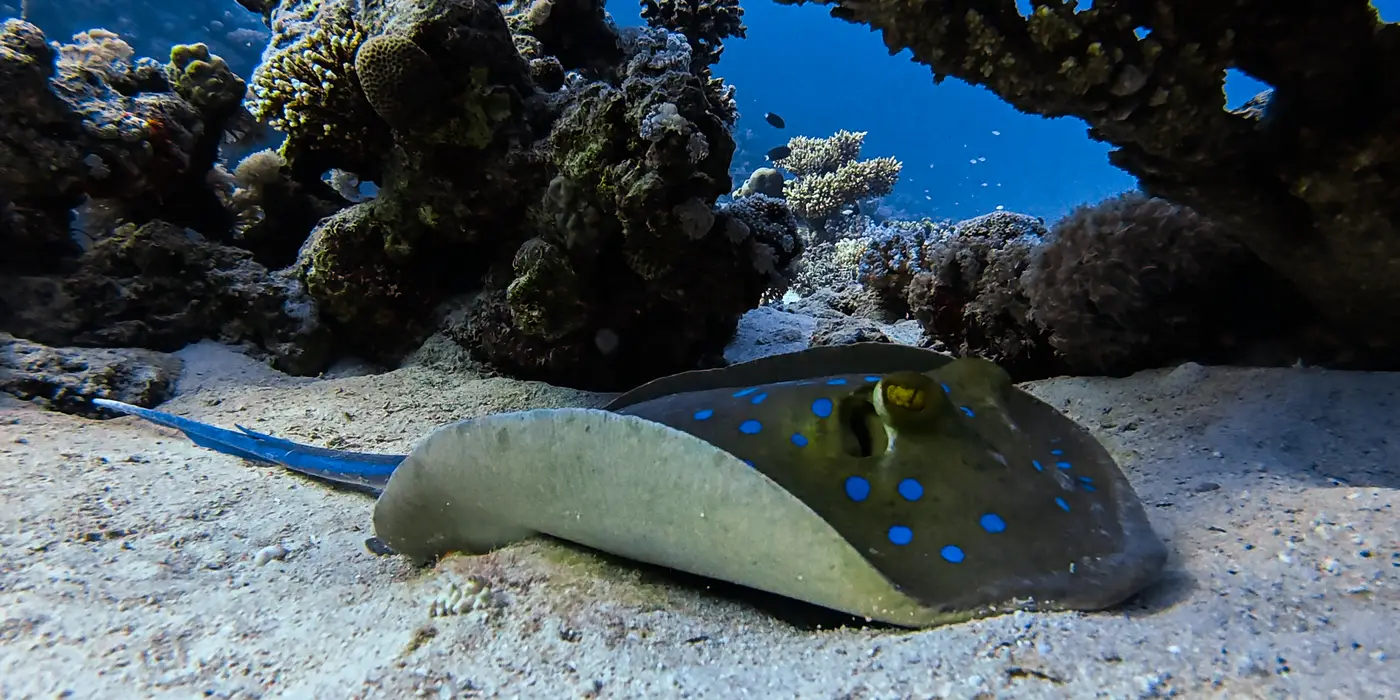
- Now and then: a great barracuda hanging still near the surface, a turtle or a torpedo ray (all reported on Soma Bay's house reefs).
- Not every reef is healthy: Hurghada's Wikipedia article cites a study that found the area's reefs declined by 50% in three decades, with dredging and pollution among the causes. That is one reason the offshore reefs usually look better.
Taking shells, coral or any living or dead marine life is forbidden by Egyptian law, the CDWS reminds guides. To know what you're looking at, see our Red Sea endemic fish guide.
Is beach snorkeling enough, or is a boat trip worth it?
Beach snorkeling is enough if your hotel has a jetty to a living reef and you're happy to swim on your own for an hour or two. A boat trip is worth it if your beach is sandy, if you want a guide in the water, or if you want to see the offshore reefs.
| From your beach | Snorkeling trip | Orange Bay trip | |
|---|---|---|---|
| Price with us | Free from a hotel beach; public beaches in Hurghada charge entry | €35 per person | €40 per person, Orange Bay entrance fee included |
| Where you snorkel | The one reef in front of you | Two stops on the Giftun, Abu Ramada or Gota Abu Ramada reefs, chosen each morning for the conditions | Two snorkeling stops plus free time on Orange Bay's beach on Giftun island |
| Guide | Usually none | A snorkeling guide in the water (CDWS maximum: 12 people per guide, fewer when conditions are less than ideal) | A snorkeling guide in the water (same CDWS rule) |
| Included | Bring or rent your own gear | Hotel pickup and drop-off, lunch and soft drinks on board, mask and fins | Hotel pickup and drop-off, lunch and soft drinks on board, mask and fins |
| Time | As long as you like | About 8.5 hours hotel to hotel, 08:00 pickup | Full day, morning pickup |
We pick up from Hurghada, El Gouna, Makadi Bay, Sahl Hasheesh, Soma Bay and Safaga. You pay cash on the day, nothing in advance, and cancellation is free up to 24 hours before.
- Want a half day? Snorkel your house reef in the morning while the water is calm. Our shortest boat trip is the private dolphin speedboat: about 3 hours, €200 per boat for up to 6 people, with pickup in Hurghada.
- Travelling with divers? Snorkelers can join our 2-dive day boat for the same €35, mask and fins included.
- Curious about going under? A try dive is €45, one-to-one with an instructor.
To choose between the island trips, see Orange Bay, Paradise Island, Mahmya or Giftun; for every snorkeling option, see best snorkeling in Hurghada. All prices are on our price list.
What should you bring for a beach snorkel?
Bring water shoes, a well-fitting mask, a snorkel, fins, a vest if you're not a strong swimmer, and cover from the sun.
- Water shoes: recommended for the rocky beach and lagoon at Makadi Bay Reef, and useful on any entry over rock. Take them off only if you're swimming from a jetty ladder.
- Mask, snorkel and fins: bring your own, or rent at the beach where it is offered. Test the mask fit before you swim out.
- Snorkelling vest or life jacket: lets you rest afloat anywhere instead of looking for somewhere to stand.
- Rash vest and hat: plus sunscreen without oxybenzone or octinoxate, put on well before you get in.
- Something warm for winter: the water is cooler from January to April. See which wetsuit you need and the water temperature by month.
- A buddy: snorkel in pairs and tell someone on the beach when you'll be back.
Frequently asked questions
Can you snorkel from the beach in Hurghada town?
You can, but Wikivoyage says the reefs are several miles offshore, so you'll see more on a boat trip. Public beaches in town charge entry, about LE50–100.
Which area near Hurghada has the best reefs from shore?
Makadi Bay and Soma Bay have reefs reachable from shore, often by a jetty to the reef edge; at Makadi Bay Reef the reef top is just 1–2 m below the surface. El Gouna is mostly lagoons and sand.
Is it OK to stand on the reef to rest?
No. Standing breaks coral and is how people step on sea urchins and stonefish. Float in a vest or on your back instead.
Can non-swimmers snorkel from the beach?
Only in a snorkelling vest or life jacket, in calm shallow water with someone right beside them. A guided boat trip, where a guide stays in the water with at most 12 people, is the easier start.
Is there a half-day snorkeling trip from Hurghada?
Our snorkeling (€35) and Orange Bay (€40) trips are full days. The shortest is our private dolphin speedboat: about 3 hours, €200 per boat for up to 6 people.
Do snorkeling boat trips pick up from Makadi Bay, Sahl Hasheesh, Soma Bay and El Gouna?
Ours do: hotel pickup is included from Hurghada, El Gouna, Makadi Bay, Sahl Hasheesh, Soma Bay and Safaga. You pay cash on the day.
What should I do if I step on a sea urchin?
Soak the area in hot water no hotter than 45 °C for 30–90 minutes, remove only spines near the surface, and see a doctor.
Can I take shells or coral home?
No. Egyptian law forbids collecting any living or dead marine life from the Red Sea, including empty shells.
Questions before you dive with us?
Message our team on WhatsApp — we're divers in Hurghada and happy to help.
Chat with us on WhatsAppSources
- Hurghada travel guide — Wikivoyage
- Hurghada — Wikipedia
- El Gouna — Wikipedia
- Sahl Hasheesh — Wikipedia
- Makadi Bay Reef — Wannadive
- Diving Soma Bay, Safaga — Scuba Travel
- Zeytouna Beach island in El Gouna — Freedom Travel
- The best things to do in El Gouna, Egypt — Love Exploring
- Manual and Protocol of Inspections for Water Sports Centres (Snorkelling Service Providers), May 2020 — Chamber of Diving and Water Sports (CDWS)
- Guidelines for boat, dive and snorkel briefings — Chamber of Diving and Water Sports (CDWS)
- Sea Urchins — Divers Alert Network (DAN)
- Stonefish sting — MedlinePlus (US National Library of Medicine)
- Wind and weather statistics: Hurghada — Windfinder
- Long-ignored jet ski ban to be enforced in Egypt's Red Sea after death — The National