Marine Life & Conservation
Mantas, whale sharks, dolphins and other big animals near Hurghada: where and how likely
Sometimes, but none of them is guaranteed. Near Hurghada, dolphins rest at reefs such as Shaab El Erg and turtles feed along the coast. Mantas pass Shaab El Erg mainly in February and March, and whale sharks appear only rarely. Hammerheads and oceanic whitetips gather at offshore reefs such as Daedalus, reached by liveaboard. Dugongs are seen mostly at Marsa Abu Dabab, far south near Marsa Alam.
By 71 Guardians · Published 04 Nov 2026
Which big animals can you see near Hurghada, and how likely is each?
Dolphins and turtles are the realistic hopes on a Hurghada day; mantas and whale sharks are occasional visitors; hammerheads, oceanic whitetips and dugongs mostly mean travelling further. Nobody can promise any of them. The table uses only the words the sources use. We did not turn them into percentages, because no survey gives sighting odds for Hurghada's reefs.
| Animal | Where in the northern Red Sea | How likely (in the sources' own words) | IUCN Red List (global) |
|---|---|---|---|
| Dolphins at resting reefs (spinner dolphins at Samadai) | Resting areas at Shaab El Erg, Fanous and Abu Nugar near Hurghada; Samadai near Marsa Alam | Seen "year-round" in the Shaab El Erg lagoons; on average 39 a day at Samadai in 2004–2006 | Spinner: Least Concern |
| Bottlenose dolphins (common and Indo-Pacific) | Recorded in boat surveys of the southern Egyptian Red Sea | "Commonly encountered" in 2010–2013 surveys of the southern Egyptian Red Sea | Common bottlenose: Least Concern. Indo-Pacific bottlenose: Near Threatened |
| Green and hawksbill turtles | Nest and feed along the Egyptian coast; greens on seagrass, hawksbills on reefs | The two species that live here; leatherback and olive ridley are "rarely seen" | Green: Least Concern (since October 2025). Hawksbill: Critically Endangered |
| Napoleon (humphead) wrasse | Coral reef slopes, channels and lagoon reefs, 2–60 m; its range starts in the Red Sea | No published sighting rate for Hurghada's reefs | Endangered |
| Eagle ray (ocellated / spotted) | Coastal waters, usually 20–25 m; the Red Sea is part of its range | No published sighting rate for Hurghada | Endangered |
| Oceanic manta | Northern Red Sea incl. Egypt; juveniles off Sharm el Sheikh; Shaab El Erg north of Hurghada has a "Manta Point" | Juveniles "regularly" off Sharm el Sheikh; at Shaab El Erg mainly February and March | Endangered |
| Reef manta | Best documented much further south, at Dungonab Bay in Sudan | Dungonab Bay has "the largest known" Red Sea aggregation | Vulnerable |
| Whale shark | Reported off Hurghada (between the Giftun islands, the Fanous area), Port Ghalib and Marsa Alam; gathers each spring off Saudi Arabia | Marine biologists call its appearance near Hurghada "rare" | Endangered |
| Scalloped hammerhead | Offshore reefs, documented at Daedalus, about 90 km off the coast | "Regularly observed" at Daedalus in groups of up to 10, in summer | Critically Endangered |
| Oceanic whitetip | Offshore reefs such as Daedalus and Elphinstone; HEPCA has warned about them at St John's | At Daedalus "mainly observed between October and November", sometimes from May | Critically Endangered |
| Dugong | Seagrass bays, above all Marsa Abu Dabab near Marsa Alam | The bay holds "the majority of dugong sightings in the Red Sea"; no rate published | Vulnerable |
IUCN categories are the global Red List listings, read from GBIF and FishBase species pages in November 2026. A global category does not always match the local picture.
Can you see manta rays in Hurghada?
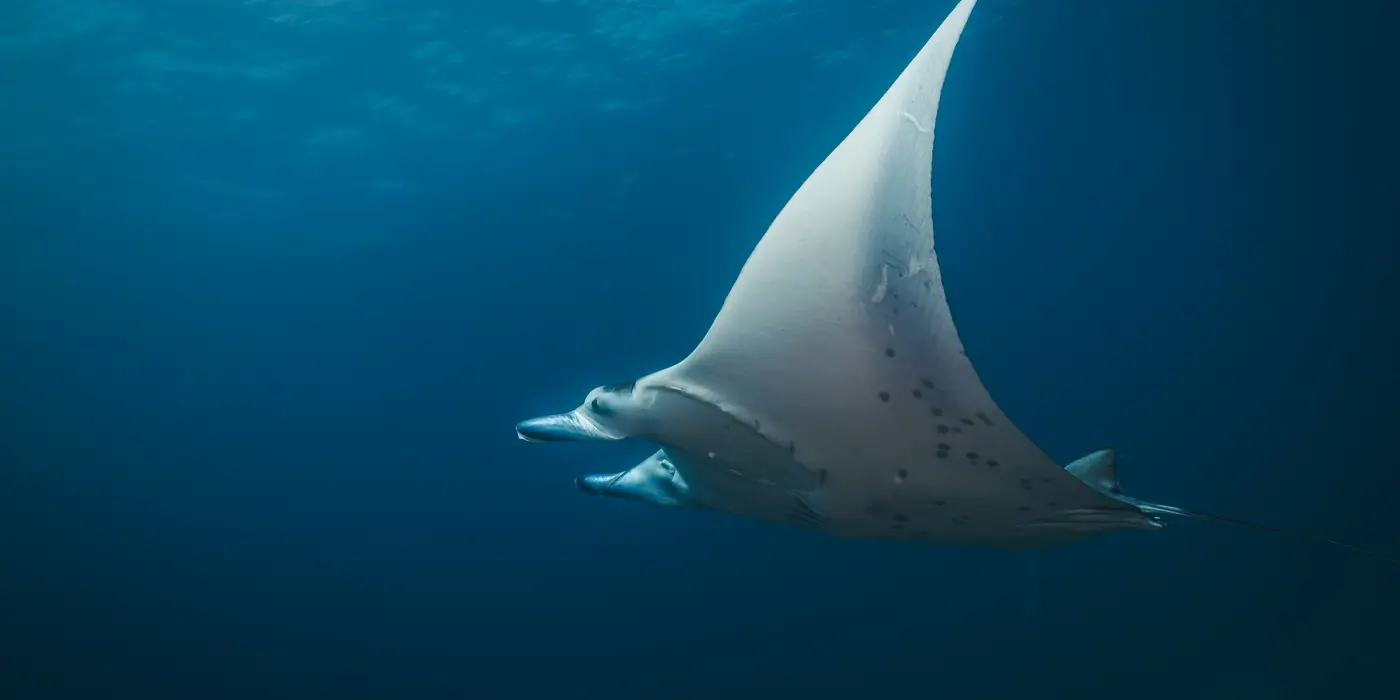
Sometimes, but not often enough to plan a trip around. One reef on the day-boat routes north of Hurghada, Shaab El Erg, has a dive site called Manta Point. A Dutch dive-site guide says mantas are met at Shaab El Erg mainly in February and March. It is about 45 minutes by boat from El Gouna.
Two manta species live in the Red Sea, and the research on them comes from different places:
- Oceanic manta. A 2022 photo-ID study (Knochel and colleagues) identified 267 oceanic mantas from 395 sightings in Egypt, Israel, Jordan, Saudi Arabia and Sudan between 2004 and 2021. Juveniles were seen regularly off Sharm el Sheikh, which the authors call a potential nursery. Some juveniles travelled at least 525 km.
- Reef manta. The best-studied Red Sea group lives far to the south, in Dungonab Bay, Sudan. A 2022 tagging study calls it the largest known reef manta aggregation in the Red Sea, with most detections in autumn.
How to behave (Manta Trust's code of conduct): enter the water quietly, no closer than 10 m. Don't splash. Let the manta come to you and keep its path ahead clear. Never chase it, because you will not catch up and it will leave. Divers should stay low near the seabed. When a manta swims towards you, stay where you are and don't rise into its way.
Are there whale sharks near Hurghada?
Yes, but sightings are rare and make the local news when they happen. In November 2018 Egypt Independent reported a whale shark off Hurghada. Red Sea reserves officials said it had been seen at Port Ghalib, in the Fanous area and between the two Giftun islands. The same article reports earlier sightings at Giftun in July and north of Marsa Alam in March 2017. It says marine biologists call these appearances rare. Hunting whale sharks is banned in Egypt.
The Red Sea's best-studied whale shark gathering is not in Egypt. It is at Shib Habil, a reef off the Saudi coast. A KAUST and WHOI study monitored 84 different whale sharks there over six years. Most came in April and May, and many returned year after year. The site regularly draws large numbers of juvenile females.
How to behave (Red Sea reserves guidance, 2018): stay at least 3 m from its head and 4 m from its tail. Never touch it, ride it or try to change its course. Camera flashes can disturb it.
Where do you see dolphins and turtles from Hurghada?
These are the big animals you are most likely to meet on a normal Hurghada boat day. Dolphins rest at a few known reefs, and turtles feed along the coast.
- Dolphins. HEPCA names Fanous, Shaab El Erg and Abu Nugar as the main dolphin resting areas near Hurghada. The Dutch guide says dolphins are seen year-round in the Shaab El Erg lagoons. Further south, a study at Samadai near Marsa Alam counted spinner dolphins every day from 2004 to 2006. On average 39 were there, but the range was 0 to 210, with fewest in early spring and most in June. Surveys of the southern Egyptian Red Sea in 2010–2013 found five common species, including spinner, common bottlenose and Indo-Pacific bottlenose dolphins. Read our Dolphin House guide and the dolphin code of conduct.
- Turtles. HEPCA says green and hawksbill turtles nest and feed on the Egyptian coast. Green turtles graze seagrass and hawksbills eat sponges and corals. Leatherback and olive ridley turtles are rarely seen now. See Sea turtles of the Red Sea.
How to behave with dolphins (HEPCA): boats stay at least 30 m away and go no faster than 4 knots. Nobody chases, circles or splits a group, and boats never follow dolphins into their resting lagoons. Swimmers slip in gently, stay beside the group rather than above it, and never touch or feed them. With turtles, keep your distance and never touch or chase them.
On our 2-dive day trip (€50, normally €60) the captain picks the reefs on the day by weather and sea state. Not diving? The private dolphin speedboat goes to Dolphin House for €200 per boat, up to 6 people.
Where do you see hammerheads and oceanic whitetips in the Red Sea?
Mainly at offshore reefs visited on liveaboards from Hurghada. Elphinstone can also be reached by day boat from the Marsa Alam area; that is a different departure area from Hurghada.
The best evidence is for Daedalus Reef, about 90 km off the Egyptian coast. Its listing as an Important Shark and Ray Area (ISRA) says scalloped hammerheads are regularly observed there in groups of up to 10, and gather predictably in summer. The same listing says groups of up to 23 oceanic whitetips have been reported at Daedalus, mainly in October and November but sometimes from May. Oceanic whitetips have also been photographed at Elphinstone. The Brothers ISRA factsheet reports groups of up to 25 oceanic whitetips and 469 individuals identified during 2003–2019, with peak encounters in October and November. Those historical observations do not promise a sighting on a particular trip.
Both species are Critically Endangered. Our Brothers · Daedalus · Elphinstone route (7 nights from Hurghada, from €1,340) visits all three reefs. It is for advanced divers because of the depth and currents. Read what to expect on the route, oceanic whitetips and sharks in Hurghada.
How to behave with sharks (HEPCA's tips): feeding and baiting sharks is illegal across the Egyptian Red Sea. Stay with your group, avoid quick or jerky movements and don't make fast ascents with a shark below you. You are most vulnerable at the surface, and staying close to the reef helps. Never touch a shark. If one circles calmly, turn with it and keep it in sight. HEPCA called letting guests snorkel at St John's and other far islands while oceanic whitetips are around "highly unprofessional".
Can you see a dugong from Hurghada?
Not on a normal Hurghada day. Egypt's dugongs are a far-south animal. HEPCA says Marsa Abu Dabab, a seagrass bay near Marsa Alam, holds the majority of dugong sightings in the Red Sea. It also says very little is known about how many dugongs live along the Egyptian coast, and it publishes no sighting rate.
Motorboats are kept out of the bay, visitors enter only from the shore and the number of snorkellers and divers is controlled. Signs ask people not to touch dugongs or turtles. Marsa Abu Dabab is a day trip by road from Hurghada, so ask us for the details. Read more in Dugongs in Egypt's Red Sea.
What about Napoleon wrasse and eagle rays?
Both live in the Red Sea and use the kind of reef you dive from Hurghada. No published survey says how often you will see either one.
- Napoleon (humphead) wrasse. FishBase says its range starts in the Red Sea. Adults live on steep outer reef slopes, channel slopes and lagoon reefs at 2–60 m. They roam the reef by day and rest in caves and under ledges at night. They are usually alone or in pairs, and males reach 229 cm. Endangered, mainly because of overfishing for the live reef fish trade.
- Eagle ray. The Red Sea species is the ocellated (spotted) eagle ray, which FishBase lists from East Africa and the Red Sea to Hawaii. It lives in coastal waters, usually at 20–25 m, and feeds on shellfish, crabs and other animals on the bottom. Its disc can be more than 3 m wide. Endangered (assessed July 2023).
With both, the rule is the same: hover, don't follow, and never touch. Our reef etiquette guide explains how to stay off the reef while you watch.
Frequently asked questions
Can you see manta rays in Hurghada?
Sometimes. A dive-site guide says mantas visit Shaab El Erg, north of Hurghada, mainly in February and March, but no sighting is guaranteed.
Are there whale sharks in Hurghada?
Occasionally. Whale sharks have been reported between the Giftun islands and in the Fanous area, but marine biologists call these sightings rare.
Where are you most likely to see hammerhead sharks in the Red Sea?
At Daedalus Reef, about 90 km offshore, where scalloped hammerheads are regularly observed in groups of up to 10 in summer. It is reached by liveaboard.
Will I see dolphins on a Hurghada boat trip?
Possibly. Dolphins rest at Shaab El Erg, Fanous and Abu Nugar, but numbers vary: at Samadai the daily count ranged from 0 to 210 in 2004–2006.
Can you see dugongs near Hurghada?
Rarely, if ever, on a Hurghada day. Most Red Sea dugong sightings come from Marsa Abu Dabab near Marsa Alam, a day trip by road.
How close can I get to a whale shark or manta?
Stay at least 3 m from a whale shark's head and 4 m from its tail. With mantas, enter the water no closer than 10 m and let them come to you.
Are these animals endangered?
Several are. Scalloped hammerheads, oceanic whitetips and hawksbill turtles are Critically Endangered, and oceanic mantas, whale sharks, Napoleon wrasse and eagle rays are Endangered.
Questions before you dive with us?
Message our team on WhatsApp — we're divers in Hurghada and happy to help.
Chat with us on WhatsAppSources
- Movements of the oceanic manta ray in the Red Sea (Knochel et al., Aquatic Conservation, 2022) — Manta Trust
- Red Sea may have a nursery for oceanic manta rays (18 September 2022) — KAUST Discovery
- Home sweet home: spatiotemporal distribution and site fidelity of the reef manta ray (Mobula alfredi) in Dungonab Bay, Sudan (Knochel et al., 2022) — Movement Ecology
- Sha'ab El Erg dive-site guide — Duikersgids
- How to swim with manta rays: a 10-step tourism code of conduct — Manta Trust, hosted by CMS
- Whale shark spotted again off Hurghada coast in the Red Sea (24 November 2018) — Egypt Independent
- Whale shark hot spot offers new conservation insights — KAUST
- Daedalus Reef ISRA (Important Shark and Ray Area) — IUCN SSC Shark Specialist Group
- Egypt: 10 tips for diving with sharks in the Red Sea (HEPCA advice, 2010) — Ahram Online
- HEPCA issues advisory after oceanic whitetip shark attack in Red Sea (20 June 2009) — HEPCA
- Dolphin Code of Conduct — HEPCA
- Spinner dolphin (Stenella longirostris) resting habitat in Samadai Reef (Egypt, Red Sea) protected through tourism management (Notarbartolo di Sciara et al., 2009) — Journal of the Marine Biological Association of the UK
- Abundance and distribution of delphinids in the Red Sea (Egypt) (Costa, PhD thesis) — University of St Andrews
- Turtles of the Red Sea — HEPCA
- Green turtle rebounds, moving from endangered to least concern (17 October 2025) — Mongabay
- Red Sea Dugongs — HEPCA
- Humphead wrasse — Wikipedia
- Elphinstone Reef — Wikipedia
- Cheilinus undulatus, humphead wrasse: species summary — FishBase
- Aetobatus ocellatus, ocellated eagle ray: species summary — FishBase
- Mobula alfredi (reef manta): IUCN Red List category, via GBIF species page — GBIF
- Mobula birostris (oceanic manta): IUCN Red List category, via GBIF species page — GBIF
- Rhincodon typus (whale shark): IUCN Red List category, via GBIF species page — GBIF
- Sphyrna lewini (scalloped hammerhead): IUCN Red List category, via GBIF species page — GBIF
- Carcharhinus longimanus (oceanic whitetip): IUCN Red List category, via GBIF species page — GBIF
- Stenella longirostris (spinner dolphin): IUCN Red List category, via GBIF species page — GBIF
- Tursiops aduncus (Indo-Pacific bottlenose dolphin): IUCN Red List category, via GBIF species page — GBIF
- Tursiops truncatus (common bottlenose dolphin): IUCN Red List category, via GBIF species page — GBIF
- Eretmochelys imbricata (hawksbill turtle): IUCN Red List category, via GBIF species page — GBIF
- Dugong dugon (dugong): IUCN Red List category, via GBIF species page — GBIF
- El Ikhwa (Brothers) Islands ISRA factsheet — IUCN SSC Shark Specialist Group
- Elphinstone Reef: access from Marsa Alam — PADI