
Skills & Training
Diving again after a long break: refresher options in Hurghada
If your last dive was more than a year ago, DAN and the training agencies advise refreshing your skills before diving again. In Hurghada you have two routes with us: a free, easy check dive as the first dive of our 2-dive day trip, or the PADI ReActivate refresher (from €70, half a day to a day). After a very long break with only a few dives, a full course may be wiser.
By 71 Guardians · Published 04 Nov 2026
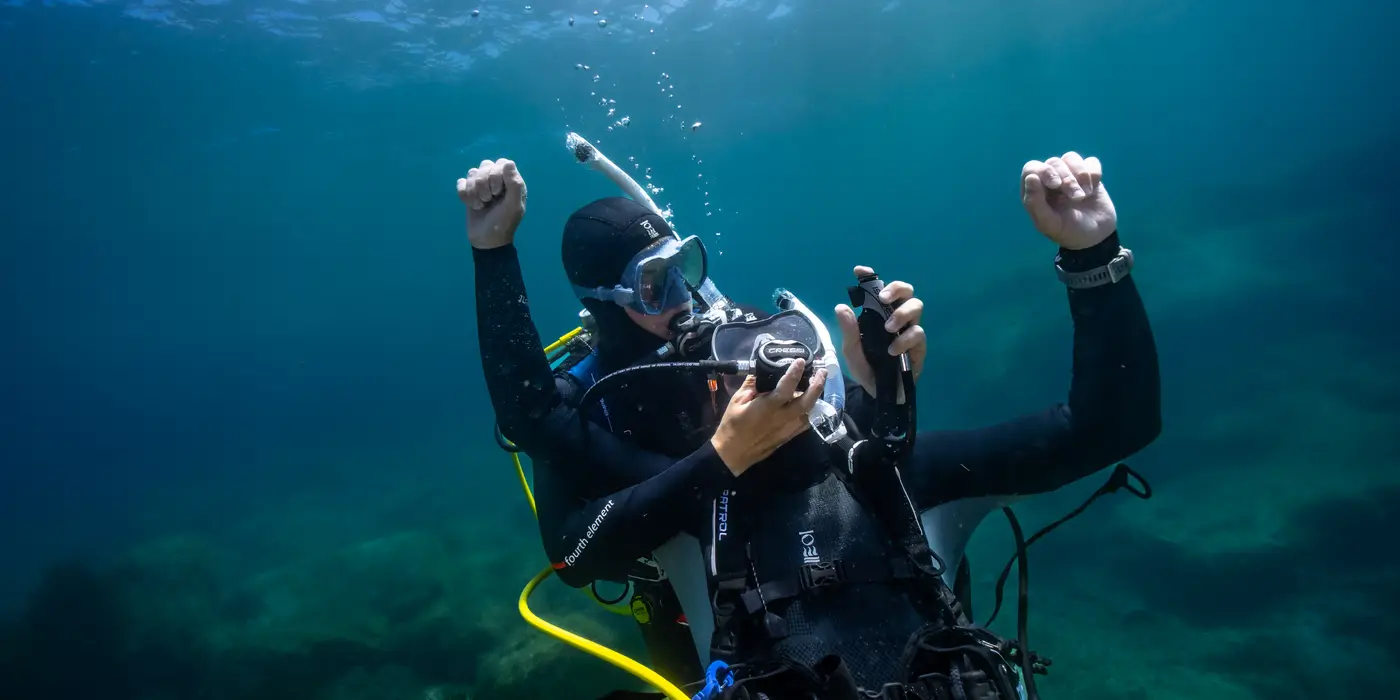
How long can you go without diving before you need a refresher?
There is no single cut-off, but most guidance points to somewhere between six months and two years. Your certification itself does not expire: the question is whether your skills and confidence are still current.
- DAN says skills degrade with as little as six months of inactivity, and that most dive educators and instructors consider one to two years without diving enough to warrant refresher training. DAN Southern Africa adds that many instructors and agencies recommend a refresher after one year.
- PADI lists six to twelve months since your last dive as a sign you may need a refresher. Some dive shops suggest one after six months, especially if you have fewer than 20 lifetime dives. With a long, logged diving history you may not need one unless it has been a year or more.
- Very long breaks: PADI says that if your last dive was more than a decade ago, you may need more than a refresher. Its example of a long break after very few dives (15 years away after about 10 dives) is a case for taking the full course again.
Why it matters: DAN's vice president of research, Petar Denoble, said in 2021 that "the data consistently show higher rates of incidents in the first dives following periods of not diving".
Which skills fade first after a break?
The hands-on emergency skills are the ones to worry about, because they are the ones you never use on a normal dive. NAUI notes that there is no published research that measures exactly how scuba skills fade. It points to related fields instead: in one study of nurses' Advanced Cardiac Life Support skills, only 30% passed the skills test at three months and only 14% at twelve months.
The skills DAN and PADI tell returning divers to practise are:
- Setting up your kit and the pre-dive safety check (BWRAF)
- Weighting and buoyancy control, including hovering (buoyancy and weighting tips)
- Mask clearing, and mask removal and replacement
- Recovering and clearing your regulator
- Sharing air and an alternate air source ascent
- An emergency swimming ascent (or controlled emergency swimming ascent, depending on your agency)
- Dropping weights in an emergency
- Dive planning and using your computer (dive computers for beginners)
NAUI's advice is to practise on real equipment rather than only re-reading your manual: doing the skill in the water keeps it far better than reading about it.
Check dive or full refresher: which do you need?
Logged experience and time away are only part of the assessment. Discuss your current skills, confidence and health with the dive professional before deciding whether a check dive is enough; if you feel nervous, have few dives or cannot remember how to set up your kit, take the refresher. The table shows the options we offer and who each one suits.
| Option | Who it suits | What happens | Price with us |
|---|---|---|---|
| Free check dive | Certified divers whose last dive was more than a year ago and who feel reasonably confident | An easy check dive as the first dive of the day on our 2-dive day trip, then the second dive of the day | Free (the day trip is €50, normally €60) |
| Extra practice dive | Divers who would like more time in the water before the reef dives | One more dive to practise | €25, only if you'd like one |
| PADI ReActivate / Scuba Refresher | Divers who feel unsure, have few dives, or whose break was long | Short theory refresh, kit set-up with an instructor watching, skills in the shallows, then back on the reef | From €70, everything included |
| Open Water course again | A break of more than a decade, or a long break after very few dives (PADI's guidance) | The full entry-level course | From €365 (SSI/SDI) or €395 (PADI) |
On every option you dive in a small group: max 4 divers per guide on day trips and max 4 students per instructor on courses. All prices are on our price list.
Whichever you choose, keep the first dive back easy: shallow, little or no current, and with a professional. DAN's advice is:
- Don't dive alone, and consider diving with a divemaster or instructor.
- Choose a familiar site that is not remote.
- Keep it shallow, with minimal or no current and no major hazards.
NAUI adds: stay where you can see the bottom, use a descent or anchor line so you can stop if needed, go slowly, and don't go deeper until you are comfortable with your equipment. If nerves build up underwater, our article on staying calm underwater explains what to do.
What happens on the PADI ReActivate refresher in Hurghada?
With us, ReActivate usually takes half a day to one day and costs from €70, all included. It is open to previously certified divers; the instructor may ask for extra training if your skills are not current.
- Theory refresh: review the knowledge topics that need refreshing, such as planning, signals and ascent rates.
- Kit set-up: you assemble and check your gear while the instructor watches.
- Skills in the shallows: mask clearing, regulator recovery, air sharing and buoyancy, until they feel automatic again.
- Back on the reef: you join a dive day, and a guided reef dive can be added to the same trip.
The price covers a PADI instructor, full scuba gear, tanks and weights, and hotel pickup and drop-off on dive days. ReActivate is not a new certification. PADI says that after the knowledge and in-water parts you receive an updated card showing your ReActivate date. PADI's own version has an online knowledge part plus an in-water session it calls optional but highly recommended.
If you trained with SSI, its equivalent is the Scuba Skills Update: no fixed length (SSI suggests 2–3 hours), five academic sessions and one pool or confined-water session, to a maximum depth of 5 m.
What should you tell the dive centre before you book?
Tell us honestly how long it has been and how many dives you have: that is how we plan the right first dive for you. Put it in the message box of the booking form or send it on WhatsApp:
- Your agency and level (for example PADI Open Water, SSI Advanced)
- Roughly how many dives you have logged, and the date of your last one
- Where you last dived and in what conditions
- Any skill you feel unsure about, such as mask clearing or buoyancy
- Any change in your health since you last dived
- Whether you have your own gear or need everything
Bring your certification card or e-card and your logbook. PADI notes that if you can't find your card, that alone is often a sign it has been a while.
Do you need a new medical form after a break?
Yes, you fill in the diver medical questionnaire again, and a long break is a good moment to check your health and fitness honestly. Our courses, ReActivate included, require the medical questionnaire.
- DAN: if you were seriously ill or have a chronic illness, talk with your doctor before you return to diving. Acute illness is incompatible with diving, and even a common cold may keep you out of the water for a while.
- Fitness: DAN suggests a plan to exercise and get back to a fitness level suitable for diving if yours has slipped.
- Doctor's sign-off: if your answers on the form mean you need one, PADI advises seeing a doctor before your trip and bringing the questionnaire and physician's evaluation form completed in advance. Our guide to the diver medical questionnaire explains which answers need a doctor.
Older divers will find more in scuba diving over 50.
What should you pack and check before diving again?
Pack your card, logbook and only the gear you want to use: full scuba gear is included on the refresher and on our courses, and costs €10 a day on the 2-dive day trip.
- Your own gear: DAN advises having it professionally serviced to the manufacturer's specifications, inspecting it for wear and getting used to any new equipment before you dive with it. PADI adds: check your dive computer's battery.
- Insurance: DAN recommends adequate, current dive accident and travel insurance (see what dive insurance covers).
- For the boat day: swimwear, a towel, reef-safe sunscreen, a hat and sunglasses, and a warm layer.
More in our packing list for a Red Sea dive holiday and rent or bring your own gear.
Frequently asked questions
Does my diving certification expire?
No. PADI says certifications don't expire; a refresher is about bringing your skills and confidence back, not renewing a card.
Is the check dive really free?
Yes. If your last dive was more than a year ago, the easy check dive is the first dive of the day on our 2-dive day trip at no extra cost; the day is €50 (normally €60).
How long does the PADI ReActivate take?
With us, usually half a day to one day, from €70 with gear, tanks, weights and hotel pickup included.
Can I do a reef dive on the same day as the refresher?
Yes. After the skills session you join a dive day, and a guided reef dive can be added to the same trip.
I haven't dived for over ten years. Is a refresher enough?
Maybe not. PADI says that after more than a decade, or a long break after very few dives, the full Open Water course may be the better choice; ours costs from €365 (SSI/SDI) or €395 (PADI).
How many divers are with each guide?
Max 4 divers per guide on our day trips and max 4 students per instructor on courses.
When do I pay?
In cash on the day, nothing in advance; cancellation is free up to 24 hours before.
Questions before you dive with us?
Message our team on WhatsApp — we're divers in Hurghada and happy to help.
Chat with us on WhatsAppSources
- 8 Signs You Need a Scuba Refresher — PADI
- Scuba diving refresher checklist — PADI
- Scuba Skills Update — SSI (Scuba Schools International)
- Period of inactivity — DAN (Divers Alert Network)
- Return to diving safely — DAN (Divers Alert Network)
- DAN Encourages Divers to Return to Diving Safely (26 March 2021) — DAN (Divers Alert Network)
- Refresh Your Skills — DAN Southern Africa
- Time To Return to Diving – But Cautiously — NAUI